
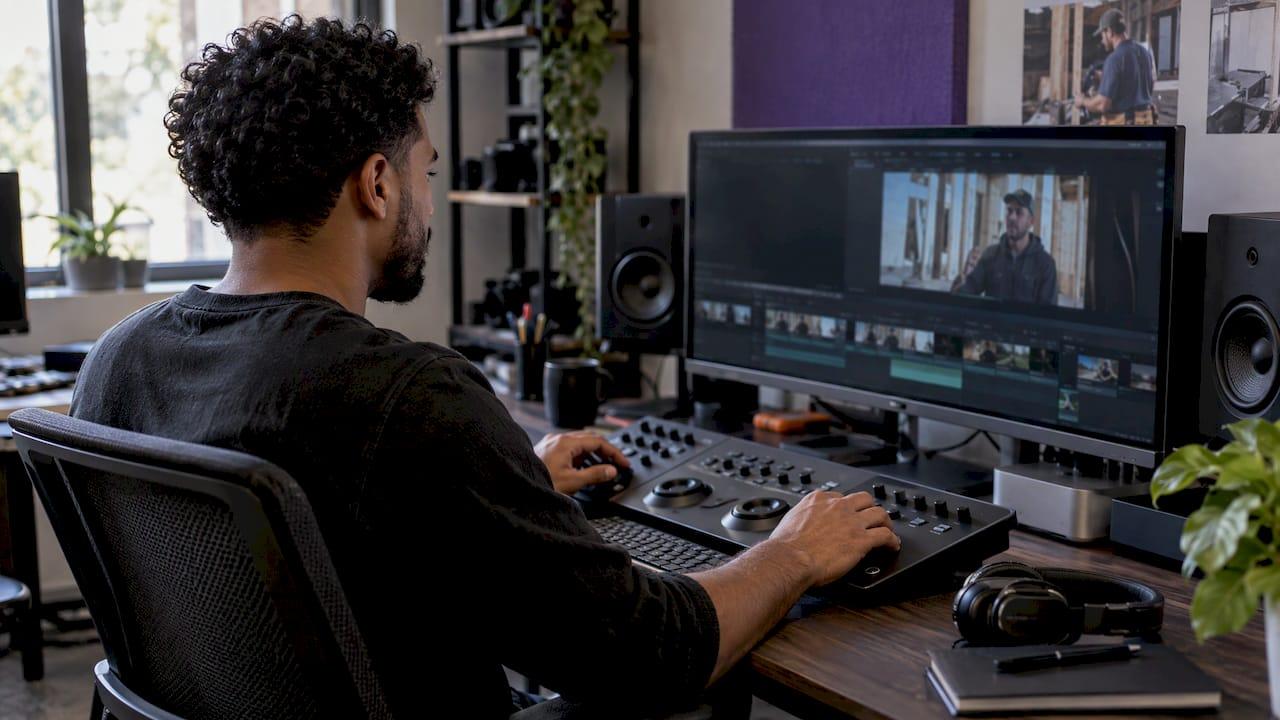
Agency video editing works for a service business when the editing is one step in a system: someone decides what the video should say, the footage gets cut and captioned, the finished clip is published on a schedule, and the leads it produces land in a CRM (customer relationship management software) where they get followed up. Editing alone does not do that. If you are a contractor, consultant or professional service owner, the question is less "who can cut my footage?" and more "who makes sure the footage turns into customers?" Our answer at Zenscape is a connected setup. Zenscape Foundations includes four strategically scripted and edited short-form videos each month, built from footage you provide, alongside the CRM and tools that handle the follow-up.
This guide explains what an editing agency does, how the process runs, how to compare pricing models, and how to decide between agency, in-house and a connected growth system.
Key Takeaways
- A video editing agency is a team with defined workflows, usually billed at a flat rate, that turns your raw footage into finished videos.
- "Unlimited" editing subscriptions often work through a one-at-a-time queue, so ask about turnaround and real monthly volume instead of the headline.
- Editing is the cheapest part of the video problem to outsource and the least valuable on its own. Script, publishing and lead follow-up decide whether a video earns anything.
- Compare agency cost against in-house on throughput, management time, speed to launch and performance risk, not on salary alone.
- For owner-operated service companies, a connected system that includes scripting, editing and CRM usually beats a standalone editing vendor.
Table of Contents
- What an agency does when it edits your video
- How the process usually runs
- Pricing models and what to ask about them
- Agency, in-house or a connected system
- Why editing alone leaves value on the table
- Where AI fits in the editing workflow
- A checklist before you choose any editing provider
- How Zenscape approaches video
- Our perspective
- FAQ
- Sources
What an agency does when it edits your video
A video editing agency is an established team that runs a defined workflow and often charges a flat rate, as Vimeo's guide to choosing editing services describes it. You supply the raw material. The agency supplies editors, a review process and delivery.
In practice the work covers a few layers:
- Assembly: trimming dead air, cutting to the strongest moments, ordering the story.
- Polish: captions, color and audio cleanup, music, titles and branded graphics.
- Formatting: vertical cuts for short-form platforms, horizontal cuts for your website or YouTube, thumbnails and short teasers pulled from longer recordings.
For a home-service company this might be a technician walkthrough, a before-and-after job clip or a customer-question answer. For a consultant it is often a talking-head explainer cut into several short clips. The raw footage is usually a phone recording, and that is enough for most service-business content.
What an editing agency generally does not do is decide your message, make sure the clip fits an offer, or route a viewer who calls after watching into a follow-up sequence. That gap matters, and we come back to it below.
How the process usually runs
Most agencies follow the same arc. AgencyPro's workflow page describes it as collecting the brief and footage, assigning an editor, sharing a first cut for review, revising in versions, recording approval, delivering final exports and then billing by project or package.
Here is that flow with the point where each step usually goes wrong.
- The brief. State who the video is for, what action you want a viewer to take and what tone fits your business. Where it goes wrong: a vague brief like "make it engaging" produces a polished clip with no purpose.
- The footage. Upload clean, well-lit, well-recorded clips with the audio you want. Where it goes wrong: poor audio cannot be fully rescued in editing, and editors cannot cut around a message that was never recorded.
- The first cut. An editor assembles a draft. Where it goes wrong: you review it as a viewer would, not as the person who shot it. Watch it once without stopping and note where your attention drifts.
- Revisions. You send consolidated notes, ideally in one round. Where it goes wrong: scattered feedback across email, text and calls leads to version confusion and slow turnarounds.
- Approval and delivery. The agency exports final files in the formats you need. Where it goes wrong: nobody owns publishing, so approved videos sit in a folder.
That last failure is the most common one for owner-operated businesses. The video is finished, and nothing happens next because no one is responsible for posting it, tracking responses or following up with the people who respond.
Pricing models and what to ask about them
Editing is typically sold in three ways: per project, per video or as a monthly subscription. The right fit depends on how steady your content plan is.
| Model | Best for | Watch for |
|---|---|---|
| Per project | A single launch video, an event recap, a website hero video | Costs reset every time, and the editor changes with each job |
| Per video | Irregular posting, testing the format | Rates can climb with length, complexity and revision rounds |
| Monthly subscription | A steady cadence of short-form clips | Queue limits, turnaround time and what counts as one request |
The subscription row deserves attention. Vimeo's guide notes that editing subscriptions commonly process requests one at a time even when they are advertised as unlimited, so what you actually receive depends on the queue and the turnaround. Before you sign anything, ask four questions:
- How many finished videos per month does the plan realistically deliver?
- What is the typical turnaround from upload to first cut?
- How many revision rounds are included, and how are they handled?
- Who writes or shapes the script, and is that part of the price?
Prices vary widely by length, style, volume and how much creative direction is included, so we do not quote a market average here. Get written quotes for the same sample video from more than one type of provider and compare what each one includes. Our own published pricing is on the pricing page.
Agency, in-house or a connected system
A useful framework for the in-house question comes from Prose Media's March 2026 decision guide. It says outsourcing can suit campaigns, launches, uneven demand, specialized work or a need for faster access to senior talent. In-house fits an always-on capability with steady output and enough internal support.
The same guide cautions against comparing agency fees with a salary and stopping there. A fair comparison also weighs throughput, management overhead, time to launch and performance risk. For a service business, translate that into your own terms:
- Throughput: how many publish-ready videos you need each month, and whether one person can produce them.
- Management overhead: your hours spent briefing, reviewing and chasing files. If you are the owner, those hours come out of sales and operations.
- Time to launch: how long until the first video is live.
- Performance risk: what happens if the videos do not generate inquiries, and who is responsible for adjusting.
An owner-operated company with one or two people in the office rarely has a spare person to manage an editor, much less a full video team. That makes outsourcing the practical route. The remaining decision is what to outsource: only the editing, or the whole chain from script to follow-up.
The hiring trap for small teams
Many owners start by hiring an individual contractor. That can work, but it brings its own paperwork: classification, contracts and ownership of the finished work. If you go that route, read a plain overview of how to hire freelancers before you hand over footage, and put the deliverables and usage rights in writing. An agency or managed service reduces that administrative load because the team, the process and the billing are already set up.
Why editing alone leaves value on the table
Take a roofing company that posts a weekly job-site clip. The clips are cleanly edited. Yet the owner still gets leads by phone with no record of where they came from, and half of them are never called back after the first conversation. Better editing would not fix that. A script built around a homeowner's actual question, a consistent posting rhythm and a CRM that logs and follows up each inquiry would.
The same pattern shows up for consultants. A well-cut explainer video that ends without a clear next step gets views, not booked calls. Our guide to business video production for service owners covers how to plan footage around the questions your buyers ask, and the consultant marketing strategy guide shows how video fits a wider plan.
A simple way to apply the 80/20 idea here comes from the University of Maryland Extension. It describes the rule as a rough pattern in which about 80% of effects may come from 20% of causes, and calls it a useful construct, not a law. Its marketing advice is to review analytics, find the posts that perform best and make more content like them. For a service business that means:
- Look at your last 20 videos.
- Note which few drew the most views, comments or inquiries.
- Identify what they share: topic, length, who is on camera, the opening line.
- Brief your next batch around that pattern.
This is editing direction, not editing skill. An editor can only cut what you brief and record. The planning loop is what compounds over time.
Where AI fits in the editing workflow
AI tools now speed up parts of the pipeline, from rough cuts to captions and upscaling. A practical overview of an AI video workflow from brief to 4K shows how the stages connect. The useful lesson is that the stages still start with a clear brief and end with a human review. Speed gains at the editing stage do not replace the decisions about message and audience. Our own approach to AI-assisted production is laid out in the AI content creation workflow guide.

A checklist before you choose any editing provider
Whatever route you take, run through these before committing:
- Sample fit: does their work in your industry look like something your customers would trust?
- Brief process: is there a structured intake, or do you start with a blank email?
- Revisions: how many rounds, how fast, and through what channel?
- Ownership: do you keep the final files and the right to reuse them?
- Scripting and strategy: is anyone helping decide what to say, or only how to cut it?
- Publishing: who posts, and on what schedule?
- Follow-up: where do viewers who respond go, and who contacts them?
- Contract: the term, the cancellation process and what changes if volume changes.
The last four are where most standalone editing arrangements go quiet, and they are the ones that decide whether the videos pay for themselves.
How Zenscape approaches video
We treat video as one part of a growth system. Zenscape Foundations costs $500 per month. It includes DIY business systems, a CRM, website and automation tools, and group support. It also includes four strategically scripted and edited short-form videos monthly, made from footage you provide. You do the recording; the scripting and editing are handled, and the CRM is there to organize the leads that come in. Foundations is a do-it-yourself platform with group support, not a done-for-you website or automation build.
If you want implementation handled for you, CEO Launch starts at $1,500 per month at the founding rate. It includes managed implementation, website build or redesign, SEO and GEO content, video production and private strategy support. Both services are described in more detail on our solutions page.

If you are not sure which fits, the free strategy call is a reasonable place to talk through your current content, lead flow and follow-up process.
Our perspective
We see video editing as a link in a chain, not a product on its own. A clean cut matters, but a clean cut of the wrong message, posted irregularly and followed by no lead follow-up, does very little for a service business.
That is why we build editing into a system. Strategically scripted short-form video gives you something specific to say. A CRM gives every inquiry a place to land and a next step. Practical automation keeps follow-up consistent when you are on a job site or in a client meeting.
We favor sustainable, compounding growth over high content volume. Four well-planned videos a month that connect to an offer and a follow-up sequence will usually serve a local service business better than a pile of clips with no plan behind them. Our packages are designed around that idea: Foundations for owners who want to run their own systems with support, and CEO Launch for those who want managed implementation.
Zenscape
FAQ
What does a video editing agency do for a business?
It takes your raw footage and returns finished videos, using a team with a defined workflow and usually a flat rate. The work typically includes cutting, captions, audio cleanup, formatting for different platforms and revision rounds. Message, scripting and publishing are separate questions to settle up front.
Is a subscription better than paying per video?
A subscription suits a steady posting schedule, while per-video pricing suits irregular needs. Check how requests are handled, since subscriptions described as unlimited often work through a one-at-a-time queue. Ask what volume and turnaround the plan delivers in practice.
When should a service business outsource editing instead of hiring in-house?
Outsourcing tends to fit launches, uneven demand and teams without a spare person to manage an editor. In-house suits an always-on, high-volume operation with internal support. Compare throughput, management time, speed to launch and performance risk, not just cost.
What is the 80/20 rule in video editing?
It is borrowed from marketing: roughly 80% of results may come from 20% of your content. It is a rough pattern, not a law. Use it by reviewing which videos performed best and briefing more like them.
Sources
- Video Editing Services: How to Choose the Right Option (Vimeo)
- Video marketing agency vs in-house: Decision tree (Prose Media)
- Video editing agency workflow and approvals (AgencyPro)
- Applying the Pareto Principle in Your Marketing (University of Maryland Extension)
- AI Video Workflow: A Practical Pipeline From Brief to 4K
- How to Hire Freelancers